Since I feel pretty absurd about my last post being all about Costco, I'm going to hash some things I've noticed about Korea and Koreans, if only to assure you that not all my time is spent sampling wholesale American products. I do spend some time making gross over-generalizations and reinforcing stereotypes for myself.
1. Koreans are fascinated with white people.
OK, I don't know if you know this or not, but Koreans are quite enamored with white people, especially Americans. Probably the media-influence thing. I catch people staring ALL THE TIME! And unlike in the U.S., people are not put off by being caught in the act of staring. I'm using it as an opportunity to practice: I will gladly take on any staring-contest challengers. Bring it.
Random people ask to take pictures with me. This has happened on numerous occasions, often at tourist sites. It makes me wonder if some day a Korean ajoshi (married Korean man) will be sat down, grandkid on his knee flipping through the old family album, "Here's me and Grandma at the Jinhae cherry blossom festival. Here's the American I said hello to, in English. Boy, was he handsome."
Which brings me to my next point...
2. Koreans think I am handsome.
Koreans think I am handsome. If we've met or you've stalked me on facebook, you know I am by no means Brad Pitt. Yet in Korean's eyes I seem to be at least his equivalent. I'm told all the time I'm, "Very handsome," or my, "Face, very good," and I get compared to David Beckham with a startling frequency. Tasteless comment warning: the following will NOT be politically correct, though it DOES NOT reflect the views, beliefs, convictions, or prejudices held by the author (me). Maybe it's like how some people think all Asians look alike. To Koreans, maybe all white people look alike. Fortunately for me, alike means akin to David Beckham. I'm not complaining, that's for sure.
3. Koreans like America.
Koreans really like that I am from America, I don't know why. Whenever I tell anyone I'm from America (or Migook, in Korean. Look at me, speaking Korean), I always get the same response: "Oh, America! Goooood!" Usually this will be accompanied by a thumbs up. I don't get why Koreans like America so much, and it makes me wonder if they just say this for every country. "Oh, Canada! Gooooood!" Or do they have a different response for each country? "Oh, Canada! That suuuuuuucks!" Maybe I'll experiment and tell people I'm Canadian, just to see what kind of responses that gets. Though the whole "Goooooood!" thing is really good for my ego. Or bad, depending how you look at it. Same goes for the David Beckham comparisons.
4. Koreans are surprised by my eating habits.
Korean people are really shocked that I can use chopsticks. They're equally surprised when I eat spicy food. Korean food is spicy, sure, sometimes very much so. But in general, it's really nothing that shocking, especially when you've been reared in a land of Mexican food, hot wings and tabasco sauce. Still, three months into my teaching tenure, I'll have coworkers look at me, baffled, "Kimchi?! You can eat kimchi?!" "Sure, it's pretty good." "No, I think kimchi is too spicy for you," as I eat another piece of kimchi. "Wow! You can use chopsticks?!"
5. Koreans have strange manners.
Eating with Koreans is a little bit difficult for me, seeing as their table manners are very different and, to me, a bit strange. First, they eat with their mouths open. Wide open, food on display, lips smacking, not a second thought. Second, the lips smacking thing. The worst is when there's someone next to you on the subway chewing gum. Next to you, across the way, at the other end of the car. Sometimes it feels like a contest who can smack the loudest. The ajoshies take the cake. A couple weeks ago Jaclyn and I were in a fairly crowded sushi restaurant when we heard someone's smacking. We turned to look, and were aghast to find that the guilt party was in literally the opposite corner of the restaurant, six tables away. Impressive, to say the least. Third, they'll keep adding and adding food until their cheeks are stretched like a chipmunk, and then add a little more. They think I'm strange because I take a bite, chew, swallow, and only then do I add more. I think maybe they developed this cavity stuffing strategy in case North Korea attacks, then they'll still have a few meals worth of calories stored away in their cheek pouches. When their mouths are filled to capacity, they'll have boisterous, shouting, laughing conversations, and with all the p, b, and k sounds in the Korean language, things can get messy. But since this is a saving face culture, when the food goes flying everyone just glances then turns a blind eye. Not the most appetizing experience, but I'm getting used to it. Plus, I get to eat however I want which is sweet. Hopefully the habits don't stick when I get home; none of you will want to eat with me.
6. Koreans have really great cell-phones.
Korean's cell-phones are really impressive. Almost all Koreans have i-phone-esque smartphones, and considering LG and Samsung are native Korean companies, they are on the very blade of the cutting edge. Some of their phones are actually mini-tablet computers, somewhere between an iphone and an ipad. They carry them around under-arm in decorative cases or in special bags (basically like a purse). Most of the phones are equipped with televisions, so they whip them out the second they get onto the bus or subway, plug in their antennas and watch away. They're all equipped with internet and cameras, which includes without fail, a mirror function... unabashed segway!
7. Koreans are vain.
America is supposed to be the country obsessed with appearance, vanity, superficiality all those traits, right? Vanity in America is NOTHING compared to what it is in Korea. There are mirrors EVERYWHERE. Every subway stop has mirrors at the top of the stairs, the bottom of the stairs, in the waiting areas, along the escalators, beside the tracks. And they are well used. Sometimes the person in front of you will suddenly grind to a halt, no warning, What on earth are they staring at over there? you think. Of course, it's themselves, of whom they caught a passing glimpse in a car window or storefront, and were mesmerized like Narcissus. The prior mentioned cell-phone mirror things are put into constant use, bus-stop, bus, subway, restaurant, wherever, and Koreans, are constantly primping and fixing their bangs, men and women alike. If they somehow missed out on the cell-phone mirror feature, then they'll take a picture of themselves, give it a peek, adjust whatever they think needs adjusting, then snap another photo, repeat the process. Once there was a girl doing this on my bus literally from when I got on 'til when I left, click, look, fix bangs, click, look, fix bangs, for fifteen solid minutes. Most impressive.
8. The Korean trash system is rad, and they use "the right kind of bags."
Koreans have this trash thing DOWN. I don't really get how it works, but you kind of just pile up trash in the street and it just disappears. You buy special trash bags, the "right kind" (whatever that means, I'm assuming they break down easily or something?), and just toss them into the pile when they're full. I guess you're supposed to use a different special trash bag for each kind of recycling, and another for yard-waste (I don't have a yard, and, like I said, I don't really get how it works so I just forgo the recycling aspect). Luckily, my co-teacher pointed out that ajummas (married women) collect all the recycling and turn it in for a premium to recycling centers, so you can pretty much dump it however you'd like and it'll vanish like it was never there. I'm tempted to start collecting recycling myself, if it's so lucrative. People also treat the trash dumps as a kind of swap meet. The other day I saw a nice set of table and chairs all wrapped up in plastic to protect them from the rain. I also saw a really interesting wardrobe a while ago, and when an ajumma caught me looking she implored that I take it then and there. At least I think that's what she was saying. She might have been mocking me for looking at someone else's garbage or cursing my children for all I know. Hard to tell with those ajummas. Finally, Korea has a nationwide composting program. You keep all your food waste in a little green tub (hermetically sealed, luckily) and when it gets to the point that opening it makes your kitchen reek for the next few hours, you wrap a little tag around the handle and leave it out overnight. The next morning, viola! All the solids, gone. The liquid they leave behind, but that is what the sewer drains are for. I really like this whole system, but I'm a little worried about what the bug/mold/rot-stink situation will be like when the summer months roll around.
9. Koreans are very efficient when it comes to space.
It seems like in the urban areas of Korea, every bit of space is utilized. I live in a very urban area, just off the edge of the Daegu industrial park and behind the new EXCO (Kenny G. is playing in June... any takers?) in a five story apartment. My window looks out on the EXCO and some other apartment buildings, but just outside, there is a farm. Yes, a farm. On first arrival I thought it was just a patch of dirt, but now that spring is sprung, every day there are workers tending the crops that have sprang up in the last month or so. There's also one just behind my school, in a tiny space between the school and a complex of high rise apartment buildings called "Paradise Land." I don't know how they do it in such a small, industrialized space, but these mini-farms are seriously flourishing in the warm weather. It's pretty inspiring: gives me hope that even if I live between an apartment building and an industrial park, I can still eke out some veggies from whatever patch of dirt is there.
Ok, that's all for now, surely more to come. Sorry if I offended anybody with my unfiltered ramblings.
Anyong!
Saturday, May 21, 2011

The greatest place in Daegu
On my Father's suggestion, I'm going to try and write brief snippets representative of my life here in Korea. For a start, I'll tell you about one of the best spots in Daegu.
This is not going to be what you are expecting. I think the single greatest place in Daegu may very well be...
Costco! Ok, I know, lame right. Don't judge me, it's not why you think. My school is right across the street, so I walk or ride by twice every day. It's great when I want to pick up 60 waffles (like I did today,) 90 rolls of toilet paper, or a gallon of dish soap. But it's not the convenient location or the American products en masse that give Costco it's undeniable appeal, nor the churros or Bulgogi bakes (basically a hollowed out loaf of bread full of cheese and succulent marinated beef. Amazing). It's the samples.
Ok, I know, lame again, right? I was struck by my first visit to a Korean Costco by the quality of the samples. Cheesecake, sliced steaks, mini-grilled cheese sandwiches. I'm telling you, there is no skimping here, this is not a matter of clearing out old stock. A couple weeks ago, they were even sampling beer. Free beer, I thought, does it get any better?! Then I stumbled upon the Krispy Kreme donuts, and had to answer my rhetorical query, Yes, it most certainly does.
But it doesn't end there.
When I polished off my last 60 pack of waffles on this mornings pb and j, I didn't fret. After all, by some auspicious turn Costco and my school are neighbors! I popped in on my way home, skipped through the bottom floor (where they were sampling vitamin supplements. Weird, I know) and up to the grocery floor, the milk and honey realm of samples. I'm not exactly sure which stars had aligned or who'd hung a horseshoe over my threshold, but there at the top of the escalator was a makeshift tasting room (more of a big table, really, like you'd see at an expo). Two whites and a red later, they must have gotten wind of my piqued interest, because they pulled out a bottle of Shiraz from behind the 150,000 won label (about 150 dollars). Not bad, not bad at all.
Not to be forestalled, I headed off for the frozen foods section. On the way, more samples of course. The first I came to was flying fish roe with sticky rice. Across the aisle, fresh Alaskan salmon sashimi, my personal favorite when it comes to raw fish. I took two.
At this point, I considered my good fortune thoroughly and advantageously depleted. I grabbed my chest of waffles and headed for the registers. But lady luck wasn't done with me yet, because as I turned to go, churros. All I could think was, This is getting absurd. A wine tasting, a sushi sampler of my favorite fish, and the desert I was probably about to buy anyway. And still, there's more, because on they way out of the frozen foods section, I happened upon a table sampling sparkling wines.
I short, American Costcos have some lessons to be learned from their Korean counterparts when it comes to sampling. Or maybe they've tried this top-shelf take on sampling and discovered the shortcomings, because even though I'm all stocked on waffles, you can bet I'll be back on Monday for a gratis after-school snack.
This is not going to be what you are expecting. I think the single greatest place in Daegu may very well be...
Costco! Ok, I know, lame right. Don't judge me, it's not why you think. My school is right across the street, so I walk or ride by twice every day. It's great when I want to pick up 60 waffles (like I did today,) 90 rolls of toilet paper, or a gallon of dish soap. But it's not the convenient location or the American products en masse that give Costco it's undeniable appeal, nor the churros or Bulgogi bakes (basically a hollowed out loaf of bread full of cheese and succulent marinated beef. Amazing). It's the samples.
Ok, I know, lame again, right? I was struck by my first visit to a Korean Costco by the quality of the samples. Cheesecake, sliced steaks, mini-grilled cheese sandwiches. I'm telling you, there is no skimping here, this is not a matter of clearing out old stock. A couple weeks ago, they were even sampling beer. Free beer, I thought, does it get any better?! Then I stumbled upon the Krispy Kreme donuts, and had to answer my rhetorical query, Yes, it most certainly does.
But it doesn't end there.
When I polished off my last 60 pack of waffles on this mornings pb and j, I didn't fret. After all, by some auspicious turn Costco and my school are neighbors! I popped in on my way home, skipped through the bottom floor (where they were sampling vitamin supplements. Weird, I know) and up to the grocery floor, the milk and honey realm of samples. I'm not exactly sure which stars had aligned or who'd hung a horseshoe over my threshold, but there at the top of the escalator was a makeshift tasting room (more of a big table, really, like you'd see at an expo). Two whites and a red later, they must have gotten wind of my piqued interest, because they pulled out a bottle of Shiraz from behind the 150,000 won label (about 150 dollars). Not bad, not bad at all.
Not to be forestalled, I headed off for the frozen foods section. On the way, more samples of course. The first I came to was flying fish roe with sticky rice. Across the aisle, fresh Alaskan salmon sashimi, my personal favorite when it comes to raw fish. I took two.
At this point, I considered my good fortune thoroughly and advantageously depleted. I grabbed my chest of waffles and headed for the registers. But lady luck wasn't done with me yet, because as I turned to go, churros. All I could think was, This is getting absurd. A wine tasting, a sushi sampler of my favorite fish, and the desert I was probably about to buy anyway. And still, there's more, because on they way out of the frozen foods section, I happened upon a table sampling sparkling wines.
I short, American Costcos have some lessons to be learned from their Korean counterparts when it comes to sampling. Or maybe they've tried this top-shelf take on sampling and discovered the shortcomings, because even though I'm all stocked on waffles, you can bet I'll be back on Monday for a gratis after-school snack.
Sunday, May 15, 2011
Getting the ball rolling!
Hello family, friends, strangers! My parents brought to my attention that it's rapidly approaching two months since I've posted anything on here... oops! Been pretty busy, let me tell you what I've been up to...
So, I'm a teacher. After a quick month of TESOL training in Thailand (aside: American TESOL institute DOES EXIST, I did get a job through them (that pays), and they did fulfill all parts of their contract! that's for you researchers) and a 10 day orientation in Busan I was tossed right into the mix, sink or swim.
I am at a school in Daegu called Moonseong elementary school, alternately spelled Munsong, Moonseong, Moonsung, or 묵성. This school is MASSIVE, with just about two thousand students. I am the primary native speaking English teacher (or NET.. Korea loves acronyms) for third and fifth grade, with some shared responsibility with the 6th graders. My schedule is, in a word, confusing. Since the school is so massive, there are no students I see more than once a week, and the sixth graders I see alternating weeks on a rotating basis. Since realizing this set-up is rather unconducive to following a lesson plan (hard to plan with the co-teacher when I only see the students one in six classes), they've given me full freedom to teach whatever I want. This is a blessing and a curse. The pure creative liberty is nice, but it's already difficult to generate ideas after six weeks of elective lessons. Not to mention the other NET at the school is in the same boat, so we're churning through potential lessons double-time. Any ideas would be well appreciated!!!
A few weeks ago I started my extra lessons in addition to the regular classes. This means a class of gifted fifth graders, a grammar and writing class for teachers, and a kindergarten class. These are some of my favorite classes, seeing as I have full liberty, and the level is more advanced so I can pretty much do anything (except, of course, for kindergarten, where the level is so low I can pretty much do nothing but play games; not complaining). I've taught my gifted class all the parts of a story, and have them in "studios" writing a movie, to be filmed at a later date (my school is well funded, so we've got cameras and a budget for props, costumes, etc.). Every week I give them a riddle or two, and they are absolutely loving that. Korea is not known for it's out of the box thinking, so the first couple weeks I really had to guide them right to the answers. It's amazing to see how quickly these kids are picking up the whole riddle, double talk, wordplay concept, and I feel like it's a really effective exercise for them in creative thinking. Last week, unprompted, I got answers for "what word starts with P, ends with E, and has thousands of letters?" and "what goes up when rain comes down?" answers can be submitted to my e-mail.. I'll mail you a fun-size pack of mike-n-ikes.
The teacher class is going really well, also. Every week they submit sentences, and I use the corrections to guide the class. Having to explain my corrections is forcing me to rush up on my grammar, too, which I definitely appreciate, and was actually the reason I elected to teach the writing class over the conversation class (taught by the other NET). It seems to be a good system, because often they're looking to translate expressions or idioms, which more often than not opens up discussion on the differences between Korean and American culture. I've been giving them some activities, as well. I start every class with a rebus puzzle, which has had a development very parallel to the riddles with the gifted students, and after warming them up to them they seem to really be getting into it. I also had them write cinquain poems, a stunning success! Four poems about students and one about soccer (by me).
Finally, kindergarten. Cute and crazy pretty much sums it up. Though I do have one girl who's practically fluent, which blows my mind every time. "Thank you for the class today, teacher. Very fun games." Soon she'll speak English better than I do. Now if I could get the rest of them to repeat after me instead of picking their noses while they stare at me with a sort of aloof, perplexed fascination.
Ok, I have to do a load of work for the aforementioned classes, but here I am, getting the ball rolling again as promised (Dad). Thanks for the push!
안녕히 겨세요!
Anyeonghi kyeseyo!
So, I'm a teacher. After a quick month of TESOL training in Thailand (aside: American TESOL institute DOES EXIST, I did get a job through them (that pays), and they did fulfill all parts of their contract! that's for you researchers) and a 10 day orientation in Busan I was tossed right into the mix, sink or swim.
I am at a school in Daegu called Moonseong elementary school, alternately spelled Munsong, Moonseong, Moonsung, or 묵성. This school is MASSIVE, with just about two thousand students. I am the primary native speaking English teacher (or NET.. Korea loves acronyms) for third and fifth grade, with some shared responsibility with the 6th graders. My schedule is, in a word, confusing. Since the school is so massive, there are no students I see more than once a week, and the sixth graders I see alternating weeks on a rotating basis. Since realizing this set-up is rather unconducive to following a lesson plan (hard to plan with the co-teacher when I only see the students one in six classes), they've given me full freedom to teach whatever I want. This is a blessing and a curse. The pure creative liberty is nice, but it's already difficult to generate ideas after six weeks of elective lessons. Not to mention the other NET at the school is in the same boat, so we're churning through potential lessons double-time. Any ideas would be well appreciated!!!
A few weeks ago I started my extra lessons in addition to the regular classes. This means a class of gifted fifth graders, a grammar and writing class for teachers, and a kindergarten class. These are some of my favorite classes, seeing as I have full liberty, and the level is more advanced so I can pretty much do anything (except, of course, for kindergarten, where the level is so low I can pretty much do nothing but play games; not complaining). I've taught my gifted class all the parts of a story, and have them in "studios" writing a movie, to be filmed at a later date (my school is well funded, so we've got cameras and a budget for props, costumes, etc.). Every week I give them a riddle or two, and they are absolutely loving that. Korea is not known for it's out of the box thinking, so the first couple weeks I really had to guide them right to the answers. It's amazing to see how quickly these kids are picking up the whole riddle, double talk, wordplay concept, and I feel like it's a really effective exercise for them in creative thinking. Last week, unprompted, I got answers for "what word starts with P, ends with E, and has thousands of letters?" and "what goes up when rain comes down?" answers can be submitted to my e-mail.. I'll mail you a fun-size pack of mike-n-ikes.
The teacher class is going really well, also. Every week they submit sentences, and I use the corrections to guide the class. Having to explain my corrections is forcing me to rush up on my grammar, too, which I definitely appreciate, and was actually the reason I elected to teach the writing class over the conversation class (taught by the other NET). It seems to be a good system, because often they're looking to translate expressions or idioms, which more often than not opens up discussion on the differences between Korean and American culture. I've been giving them some activities, as well. I start every class with a rebus puzzle, which has had a development very parallel to the riddles with the gifted students, and after warming them up to them they seem to really be getting into it. I also had them write cinquain poems, a stunning success! Four poems about students and one about soccer (by me).
Finally, kindergarten. Cute and crazy pretty much sums it up. Though I do have one girl who's practically fluent, which blows my mind every time. "Thank you for the class today, teacher. Very fun games." Soon she'll speak English better than I do. Now if I could get the rest of them to repeat after me instead of picking their noses while they stare at me with a sort of aloof, perplexed fascination.
Ok, I have to do a load of work for the aforementioned classes, but here I am, getting the ball rolling again as promised (Dad). Thanks for the push!
안녕히 겨세요!
Anyeonghi kyeseyo!
Tuesday, April 5, 2011
Dynamic Korea, episode II
 |
| Greetings from my apartment in Korea! |
In case you don't already know, I was placed in Daegu (or Taegu, depending on who you ask), which is the third largest city in South Korea after Seoul and Busan. It's huge. At least by my small-town standards. Though 2.5 million is pretty large by anyone's standards, I should imagine. Take a look:


It's self given name is "Colorful Daegu," and on a clear day from a lofty vantage point, the moniker really holds true. I think it's the roofs. But, as with most things, pictures don't really do it justice.
Here is my apartment:
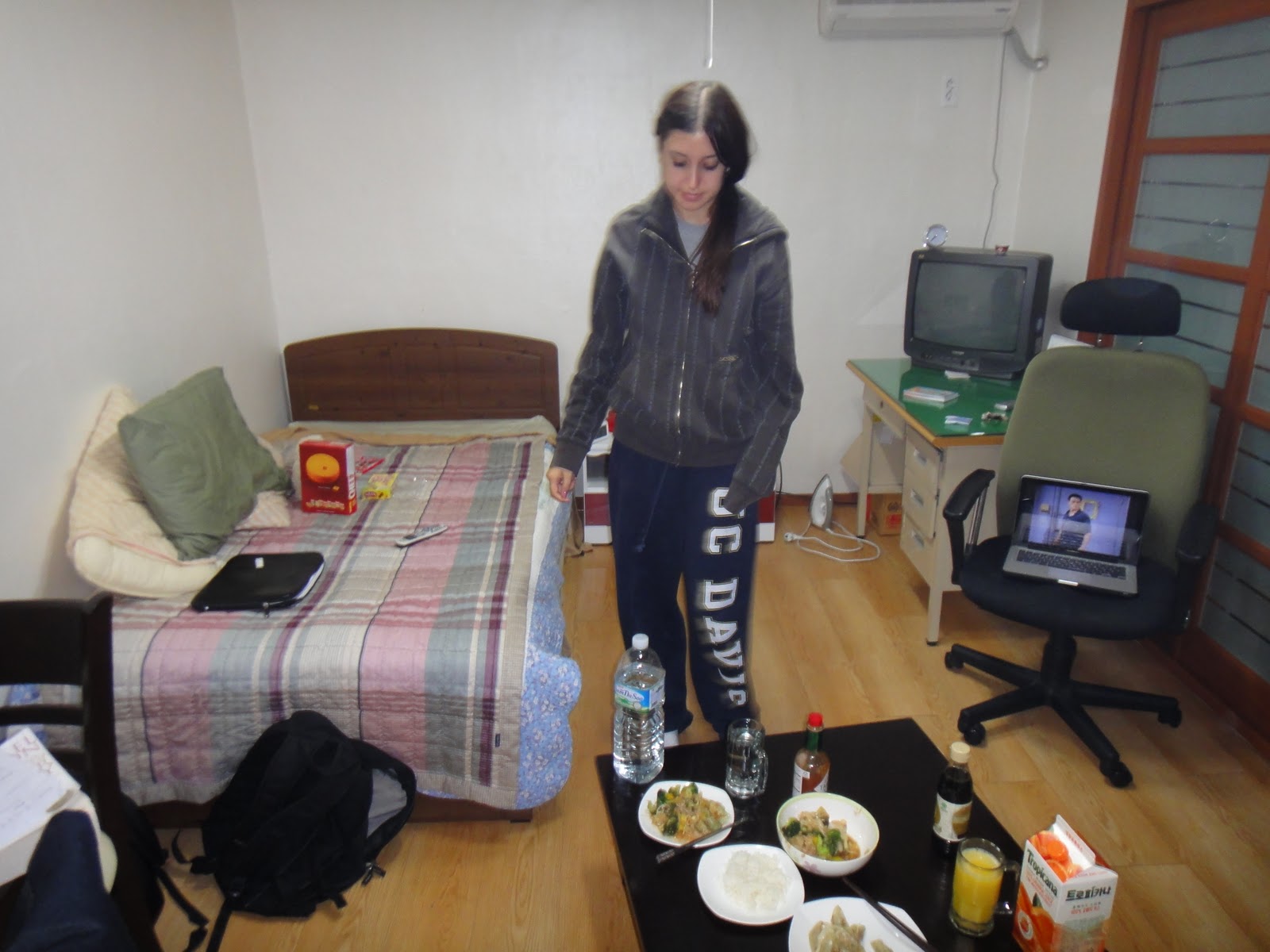


So that's my apartment. Take note of the exotic Korean products: Cheez-its on the bed, Tropicana orange juice and Tobasco sauce on the table, a Dole pineapple on the fridge. Living on the edge, so they say! The apartment is quaint and lovely, finely furnished and fashionably decorated with a chic design motif. Ok, so the last part is complete b.s. (there are about eleven different patterns of wallpaper. My favorite is the checkers in the kitchen), but it is a really homey apartment and I've done well to make it my own.
In case you were worried I've created a bubble of westernization for myself, take a peep at the picture below and allay your fears.

This is a consummately Korean dish, Bibimbop, crafted in my very own kitchen(ette). The name literally means rice mixed with vegetables, then you top it off with a fried egg and some sauce. Mashiseo (delicious)!! Don't ask me what the vegetables are, I have no idea. I bought them at this amazing open air market near my house.
Which brings me to my next topic: Korean food. In a word, it's good. Real good. So good, we were inspired to make the quintessential Korean dish for ourselves at home. Food in Korea is done very differently from back at home, particularly in the restaurants. We think of meals as a communal experience, a time to come together and share food, drink, and each other's company. Koreans take this idea and elevate it, literally sharing their food. Literally. Maybe you've heard of Korean barbecue (the greatest dining experience ever), where you're brought raw meat and cook it on a grill built into your table. It looks like this:


...absolutely covered with all sorts of side dishes (the silver tube hanging down is an exhaust fan, the scissors are to chop up the meat). I learned shortly after my arrival that this communal, do it yourself procedure is not limited to their version of the barbecue. In one restaurant we went to, the "tables" were a giant skillet with a rim of wood going around. They brought us chicken, sauce, and raw vegetables which we stir-fried ourselves. In another restaurant, they boiled a huge pot of broth and vegetables on the table's built-in gas stove, and we cooked rolled up, freeze-dried beef in the resulting stew. And aside from the cooperative manner of cooking and eating, every meal is an adventure: even though I've learned to read Korean fairly well, I still haven't the foggiest idea what I'm ordering most of the time.
New vein of thought....
Not to give anyone any cause for worry, but Korea is a country at war. You've probably heard. However, it's hardly noticeable when you're here. I think we hear more about it on CNN in the states than they hear in Korea. However, there are certain reminders. I see and hear fighter jets every day, which is new for me. I'll be in school, teaching students how to pronounce "ruler" (incredibly difficult since they don't distinguish between R and L sounds in Korean), and a fighter will rip through the sky, rattling the windows as they boom past. Another, somewhat more frightening reminder, are these, found in every subway station:


In case you can't tell, those are gas masks on the left and sandbags on the right (not for floods). While the jets going overhead are merely an annoyance (and kind of cool, really), the presence of gas-masks and sand bags in every subway terminal is a provocative reminder of the real risks associated with living in a war-state.
And with that reassuring thought (sorry mom!)... until next time, take care and best wishes!
Saturday, March 19, 2011
Dynamic Korea, first installment
Hello again people out there! I'm sorry I haven't had a chance to write in a while, things have been pretty crazy, and I've been awfully busy now that I've gotten to Korea. I got so far as making a list of all the Thailand adventures I have left to write about, but that was the extent of it. By my best estimation, it's been nearly a month since I've written that list, and since I've been getting requests to give some updates on Korea, I'll leave that on the back-burner for now. Some tidbits to look forward to: the city overrun by monkeys, Lopburi, UNESCO world heritage site Ayutthya, and heaven realized on earth, Ko Phi Phi. Eventually I'll get around to posting that elusive Thailand retrospective, but, for now, onward and upward!
Well then. As you probably know, or if not you've hopefully come to the conclusion by reading the foregoing, I'm in Korea! My home away from home! I feel like it still hasn't completely sunk in that Korea is my home for the time being; it still looks funny when I write it.
Life has been a whirlwind since I arrived here. First it was ten days of EPIK (English program in Korea) orientation in Busan. This meant four hour-and-a-half lectures each day, with an interregnum halfway through for an incredibly anti-climactic field trip to the POSCO steel plant (a two hour drive each way, a fifteen minute bus tour through the expansive grounds with a non-English speaking tour guide, and a two minute pass through a random bit of the factory; photos prohibited). More than anything, orientation was a review of the TESOL course and an excuse to meet other English speakers living in Korea. We developed quite the expat community with the connections we made there.
Busan is a beautiful city, much larger than it seems by some illusion of the ocean and the towering pine green mountains sprung up throughout. You'll seem to be coming to the edge of the city, then you'll crest a hill and a whole new expanse of skyscrapers and urban sprawl will reveal itself. It's modernity is inspiring after a month in the pervasively destitute atmosphere of Thailand. Coming back to an industrialized, developed country felt like a sort of home-coming, and at the very least starting this Asian epoch in Thailand helped soften the culture shock. Take a peak at this noteworthy analogue between famous landmarks:
Seriously, they do love neon. I thought the neon in Bangkok was impressive. It's nothing compared to Korea. Here's just a little sample:
 This is just a drop in the pail, and honestly this picture doesn't even begin to do the spectacle justice. The signs move and flash and change colors, and every building seems to be plastered with them. The businesses start on the ground floor (or often-times the basement) and go all the way to the roof in nearly every building, each with it's own neon sign. The effect is dazzling corridors of neon thirty, forty, fifty feet high. The night-scape of Hyundai beach in Busan is spell-binding. Unfortunately, I forgot my camera that night, so you'll just have to pop on over and see it for yourselves.
One aspect of Korea has made acclimating a challenge: NO ONE speaks English. Now, I know you may be saying, "Duh, Tyler, it's Korea, people speak Korean." True enough, but traveling in Thailand gave me an extremely skewed perspective of English saturation in Asia. Thailand's economy relies on tourism, and tourists, no matter where they're from, communicate with the locals in English. We would chuckle about hearing a conversation between a Thai local and European or Asian tourists, broken English on both sides, and say to ourselves, "We're so lucky to have been raised speaking English, we can get by anywhere." This misconception was swiftly rectified upon arrival in Korea. In Thailand, the people possess some magical ability whereby they can understand a language they don't speak. In Korea, my ability to produce universally comprehensible gesticulation is compounding daily.
That should be enough to get you all started on the Korean leg of my journey, don't want to give you too much at once and have you get unduly saturated with my musings and reflections (sarcasm intended). I just had internet installed in my apartment, so if the posts don't start flowing again I'm probably really busy (or just being lazy). Best wishes, everyone!
Well then. As you probably know, or if not you've hopefully come to the conclusion by reading the foregoing, I'm in Korea! My home away from home! I feel like it still hasn't completely sunk in that Korea is my home for the time being; it still looks funny when I write it.
Life has been a whirlwind since I arrived here. First it was ten days of EPIK (English program in Korea) orientation in Busan. This meant four hour-and-a-half lectures each day, with an interregnum halfway through for an incredibly anti-climactic field trip to the POSCO steel plant (a two hour drive each way, a fifteen minute bus tour through the expansive grounds with a non-English speaking tour guide, and a two minute pass through a random bit of the factory; photos prohibited). More than anything, orientation was a review of the TESOL course and an excuse to meet other English speakers living in Korea. We developed quite the expat community with the connections we made there.
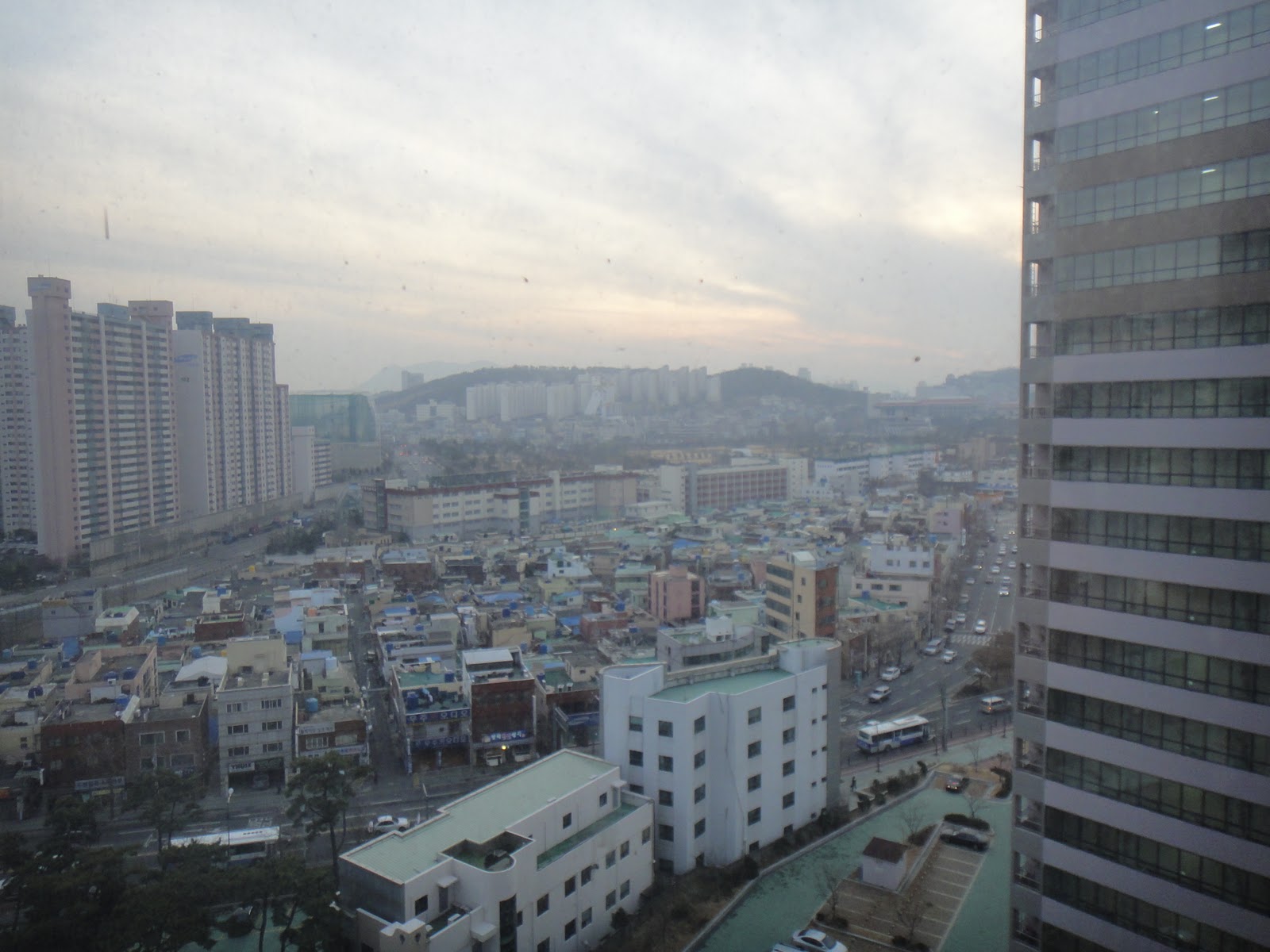 |
| Busan from my orientation dorm-room. |
 |
| Everyone knows this bridge... |
 |
| It looks a lot like this bridge! Except this one is lit up all neon at night instead of yellow. They LOVE neon around here. |
Seriously, they do love neon. I thought the neon in Bangkok was impressive. It's nothing compared to Korea. Here's just a little sample:

One aspect of Korea has made acclimating a challenge: NO ONE speaks English. Now, I know you may be saying, "Duh, Tyler, it's Korea, people speak Korean." True enough, but traveling in Thailand gave me an extremely skewed perspective of English saturation in Asia. Thailand's economy relies on tourism, and tourists, no matter where they're from, communicate with the locals in English. We would chuckle about hearing a conversation between a Thai local and European or Asian tourists, broken English on both sides, and say to ourselves, "We're so lucky to have been raised speaking English, we can get by anywhere." This misconception was swiftly rectified upon arrival in Korea. In Thailand, the people possess some magical ability whereby they can understand a language they don't speak. In Korea, my ability to produce universally comprehensible gesticulation is compounding daily.
That should be enough to get you all started on the Korean leg of my journey, don't want to give you too much at once and have you get unduly saturated with my musings and reflections (sarcasm intended). I just had internet installed in my apartment, so if the posts don't start flowing again I'm probably really busy (or just being lazy). Best wishes, everyone!
Wednesday, February 23, 2011
Bangkok Times pt. 2
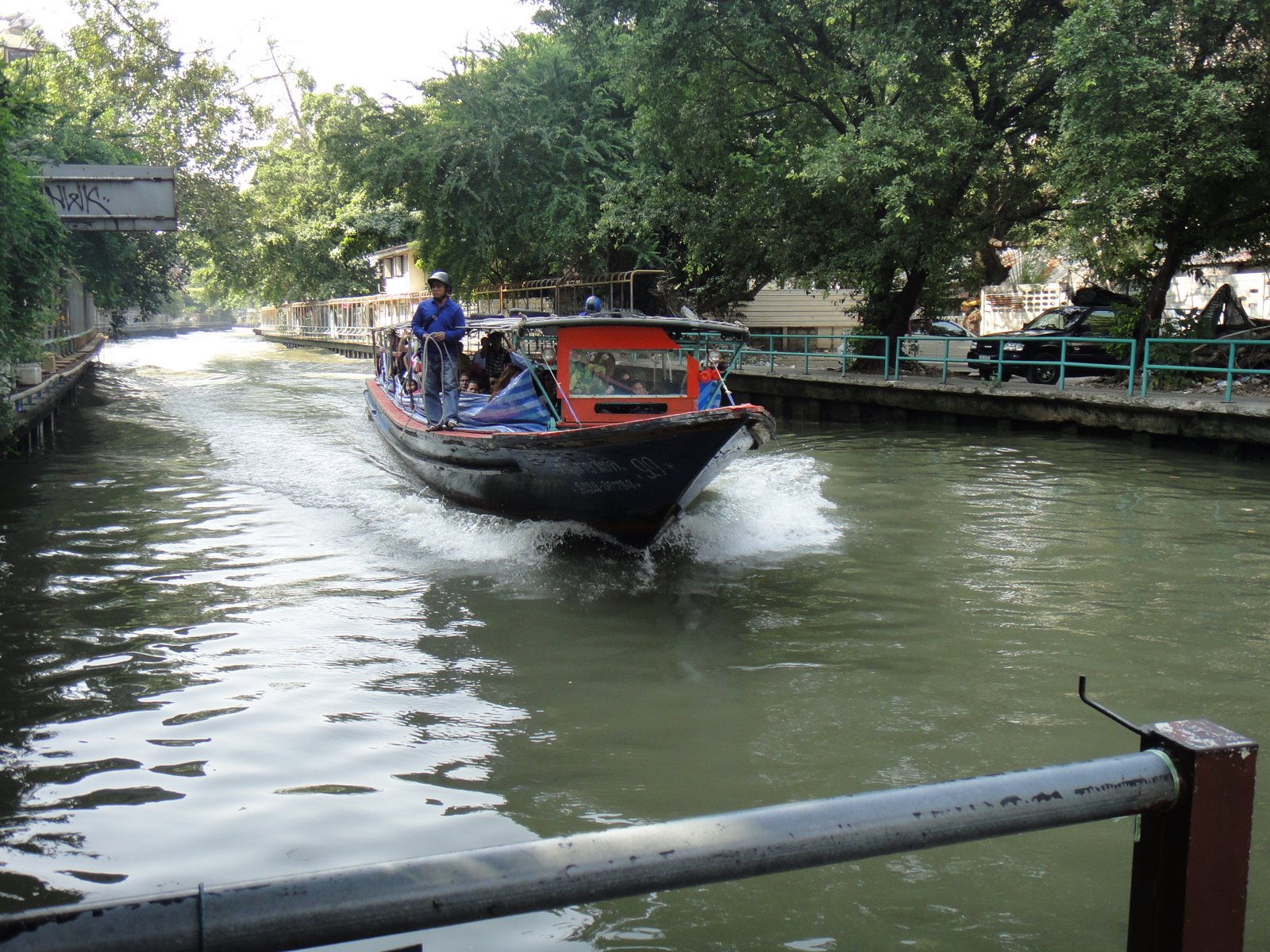 |
| Splish Splash |
 |
| Safety is the number one concern (clearly) |
 |
| A very brave Thai man, watching the world go by |
 |
| A typical boat-stop... the guy hanging off the side leaps out, wraps a rope around the vertical metal pole, waits just a second then they're off again. |
 |
| High-risk photo |
 |
| Some cabs had rather explicit "not permitted" graphics: No assault rifles, no machetes, no mad cow disease....... |
 |
| Pink cab |
 So then there are these things called tuk-tuks, which I'm fairly certain are unique to Thailand (don't quote me on that one). They're these little open air cabs that cater mainly to tourists. You can tell by their exorbitant prices, and by the fact that you only ever see white people riding in them. A ride on one of these things is a lot like Mr. Toad's Wild Ride, just with more exhaust fumes. They're really quite fun, though, so much so that I tried to take one for myself (with no success, unfortunately). All in all (have I used that expression already?) , they're fast, fun, and a definite necessity for any trip to Bangkok.
 |
| This is pretty much what the world looks like when you're riding in one of these things. |
They also employ another form of taxi transport, via moto-bike drivers in bright orange vests. You'll see these weaving through rush hour traffic with business types riding in the back seat, ladies riding side saddle with aplomb, hands floating freely, high heels dangling precariously inches above the unforgiving asphalt. Unfortunately, I had an experience with just how unforgiving that asphalt is. While on a bus in the town of Ayuthaya, we happened upon a gruesome accident appearing to have transpired only moments before. I won't go into gruesome detail, instead I'll make the abominably ignoble pun that my fanciful hopes of taking a ride on a moto-taxi weren't the only things dashed that day. I apologize for the contemptible word play, but in all honesty it was an incident of horrific circumstance and even more horrific result, and I've been finding myself anonymously wishing the best and giving heartfelt condolences to any and all of the victims affected by that tragedy.
Moving forward (and feeling luc for it), another of the street level transportation systems is the public busses. These things are almost as prevalent as the taxis and tuk-tuks, if not more so, at least in terms of sheer bulk. These behemoths will whiz by mere inches from the sidewalks (as a pedestrian you've got to keep your elbows tucked in. Seriously). I only took one inner-city bus trip in Bangkok, and it was one too many. More often than not, the busses go without air-con, they are generally packed to the brim, and assuming you manage to properly interpret the haphazard route/bus numbering system and make it onto the appropriate conveyance, you're going to do more sitting in traffic than proceeding to your destination. They're cheap as dirt, though; they do have that going for them.
Last but not least, on the highest strata of Bangkok transportation (barring airplanes, of course) is the sky-train (ala Springfield of the Simpsons). This thing isn't all that impressive really, basically a suspended subway, but it truly is a marvel of engineering. In a city where they take full advantage of, and in fine fashion, the powers of concrete, this truly is the apex of their efforts. Ian, if you're reading this thing, these pictures are for you (if you've not Ian, feel free to enjoy them anyway:
 |
| This is a spot where three railways converge. Impressive, no? The things with railings are large, interconnected aerial train stations slash crosswalks. The train is the blue thing, top left. |

 |
| Now that's what I call structural integrity. |
Speaking of things I've forgotten, I did a lot of ranting in Part 1 about the infinite purchasing opportunities and the congested sidewalks of a typical Bangkok street. Here is a prime example of what I mean:

And with that, I bid you Sawadee krap!

And with that, I bid you Sawadee krap!
Friday, February 18, 2011
Bangkok Times, pt. 1
 |
| It should say: "Bangkok, City of Shopping" |
 Bangkok. After three weeks of living here, I'm still not really sure what to say about it. It's wild, that's for sure. Unique, also, but bearing resemblence to a lot of other places I've been. It's a strange thought, but it seems like the more places I travel to and experience, the more alike they all seem. Maybe I am just getting better at spotting the similiarities..
But anyway, Bangkok is a giant mall. Seriously. If we've ever met, you know I am prone to hyperbole, but I am not exaggerating when I say that EVERY inch of free space in Bangkok is taken up by vendors, selling fake purses, mystery meat on a stick (tastier than it sounds), fingernail clippers, shirts, ties, counterfeit watches, fresh squeezed juice of various varieties (as tasty as it sounds), tailored suits, fake jerseyes, fake shoes, pirated dvds, coin purses, everything you could ever want, need, or imagine you might someday want or need. And those are just the street vendors.
 |
| You can buy fresh fruit on the street.... |
 |
| ...or even Krispy Kremes !! |
 |
| The famous Khao San Road, the backpackers hub of southeast asia. |
Bangkok has the most outrageous malls I have ever seen, and their abundance is astounding. In our area, Bangkapi, if you left from our street, soi 23, you'll hit a mall within 5 minutes. That is, you'll hit a mall in five minutes if you leave in the middle of the day, before the night market traffic raelly kicks up. The sidewalk is so thick with vendors and shoppers that a 5 minute walk at noon is a 25 minute walk at 9 oclock. If you take a right from our little street, you'll pass 2 malls before you get to the big mall, aptly named "The Mall," which is so large that it is on both sides of the street connected by a pedestrian overpass, complete with moving walkways (like the ones in the airport). I bought some slacks at this mall, they were really nice and they hemmed them right there for me. This mall is pretty classy, but it's nothing compared to the ones downtown.
 |
| How many stories? No idea. |
In the Siam area, they put on no airs about their utter devotion to commercialism. This area is literally mall after mall after mall after mall. From what I can tell, there are at least 6 malls mashed right up on top of each other, each more elitist than the last. We found a shop that sells bagels in the MBK, so the time we spent in this area was primarily absorbed in wandering the 7 stories trying to relocate said shop. It is at least 7 stories, there easily could have been more. The place is such a maze that it's really hard to say.
When we did venture out of the MBK, we discovered a whole bank of additional malls, the Siam Center, the Siam Discovery, and the Siam Paragon. The Paragon truly lives up to it's name, as a model mall for all other malls to aspire to. It's the kind of mall that is more space than product, with a single item to a shelf and track-lighting everywhere. Every designer brand you can imagine has a store-front here, and when I say designer I mean names like Rolex, Chanel, Philip Patek, Gucci, Lambhorgini (yes, that Lamborghini), Armani, every Parisian-Milano trademark you can think of. This mall is equipped with an imax theater and even, I kid you not, an aquarium. You can practically taste the pretension in this place. The auto-administered moniker of this preeminent purchasing paradise is, "The Pride of Bangkok," but when you happen through any other part of the city, or even just the sidewalk out front, you can't help but think of what a minuscule minority the mall actually serves.
As an outsider, my impression of Bangkok makes me think they should take pride in the multitude of life and culture that thrives here, and the vast amount of activity that takes place all day every day and deep into the night (perhaps with some exclusions to be made in the latter category). Possibly the most amazing and undoubtedly mystifying aspect of this city is it's system of transportation, by some miracle existing simultaneously as simple and complex, archaic and forward-thinking. Their transportation network makes the human circulatory system look like the track at the Daytona 500. It operates on an astounding number of levels, the lowest being (naturally) the subterranean. Their system puts BART to shame, it is immaculately clean, fast, prompt and frequent. It's escalators are outrageous, I saw one that must have gone at least 200 yards. I say at least, because I literally could not see either end. I'd have taken a picture for you, but none are allowed down there.

The next level up is a system of canals with commuter boats. This is our main link to the rest of town, and is an exciting experience. It is loud and it smells horrible, and often gets very crowded (example at right ==> ). You wait on a pier and occasionally have to dodge a sewagey wave, and have only a moment to leap on before they churn off to the next pier. On our first attempt we weren't aware of the necessary swiftness, and watch, perplexed, as the boat bumped the pier and chugged off again, leaving us scratching our heads in its wake (pun intended).
no more time, got to run mid thought... will finish this later!

Subscribe to:
Posts (Atom)